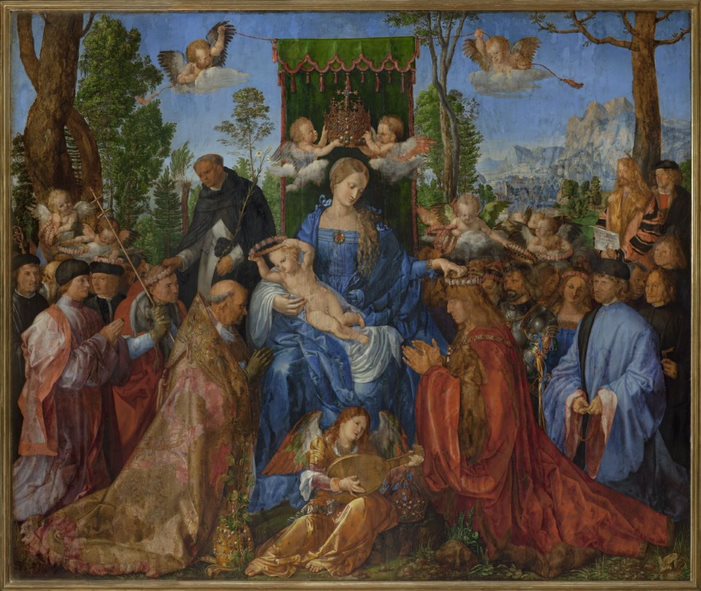
This beautiful painting, Feast of the Rosary, was created by the German Renaissance master Al-brecht Dürer. It was painted in 1506 when Dürer, while sojourning in Venice, received this commission from German merchants who resided in the city on the lagoon.
The painting was intended for the Church of St. Bartholomew situated not far from the Rialto Bridge in the very heart of Venice. It quickly became a sensation and was admired by Venetian personalities as well as city visitors. About a hundred years later, Habsburg Emperor Rudolph II, great admirer of art residing in Prague, aspired to have this beautiful painting in his collections. He succeeded. In 1606 he purchased the work and had it – in a very complicated way – transported to Prague. Even at that time there were concerns about the fragility of the work, because this oil painting was not made on canvas, but on a poplar panel. That is why it was wrapped in carpets and literally carried by several strong men across the Alps.

The title of the work is the Feast of the Rose Garlands.
So, let’s have a look what it actually depicts. It is an ideal feast of the Confraternity of the Rosary during which the Madonna and the Infant Jesus bless the participants with rosary wreaths. The work masterfully combines the German sense of detail and bold colours so typical of Venetian painting. The composition is clearly symmetrical. In the middle, the enthroned Madonna and Infant Jesus, clad in a beautiful blue dress. On the left side are representatives of ecclesiastic power, led by the kneeling Pope in the foreground. On the opposite side are representatives of secular power, led by King Maximilian, the future emperor. At closer examination of the individual faces we realise that they show portrait features. It means that the artist painted particular people of his time. Unfortunately, today we cannot identify who they were. But there is one person we can identify with certainty. It is the artist himself. He depicted himself standing under the tree and holding a note, in Italian called a « cartellino », stating that this work was created by Albrecht Dürer in 1506.