František Kupka lived between 1871 and 1957. He was a Czech painter, illustrator and caricaturist of world importance. His works are part of the collections of the Museum of Modern Art in New York, Guggenheim Museum, Centre Pompidou in Paris, and, of course, the National Gallery Prague. František Kupka was a pioneer of Abstract art. Most of his life he lived in France.
František Kupka was born in a small town in Eastern Bohemia. He soon showed great promise and with the intercession of a family friend he was allowed to study at the Academy of Fine Arts in Prague. After several years he left for the Academy of Fine Arts in Vienna where he studied not only painting, but also philosophy, Eastern religions, and spiritualism, and was also interested in mysticism. In Vienna he met Danish fashion designer Maria Bruhn who became his girlfriend. Together they even made a trip to Denmark. In 1896, Kupka moved to Paris. Soon afterwards, Maria Bruhn died, bequeathing Kupka a small inheritance. Thanks to this Kupka was able to rent a studio at Montmartre, but the beginnings were not easy. He made his living mostly as an illustrator for satirical magazines.
Kupka’s work underwent a striking development – from Symbolism to Abstract painting. It was in the Symbolist manner that he worked at the turn of the 19th and 20th centuries. The canvas Ballad (Joys of Life) from 1901–2 dates precisely to this period. It depicts two women, unrestrained and very sensuous, riding horses. The horses are unsaddled and even unbridled. The women are basking in the setting sun. These are real characters – two lovers of František Kupka. The blond-haired woman is Danish designer Maria Bruhn, at that time already deceased. The dark-haired woman is the French model Gabrielle. In this painting Kupka wanted to express joys of life, the feeling of happiness and bliss. The reverse side of the painting carries a notification mentioning Epona. Epona was a popular goddess in Celtic mythology, often depicted riding a horse. In this symbolist painting, Kupka thus blended his personal story with Celtic mythology.

The painting Amorpha, The Fugue in Two Colours is a result of Kupka’s long-term development from figurative to abstract painting. It was preceded by numerous preparatory studies, from which we know that Kupka was observing his stepdaughter, Andrée, holding and tossing her red-blue ball. Kupka was most interested in the trajectory and dynamics of movement. He blurred the depicted subject and its background into an autonomous reality. In this way he managed to merge space and time into a single scene. The title Amorpha, The Fugue in Two Colours may refer to the work of the composer Johann Sebastian Bach. Kupka himself stated in an interview that he aimed to create an artistic equivalent of Bach’s Fugue. This work, absolutely essential for the Abstract art, was exhibited at the Salon d’Automne in Paris as early as 1912.

Verwandte Blog-Beiträge

The French Collecion: Auguste Renoir - Lovers | Highlights fr...

Petr Brandl – Simeon with the Infant Jesus | Highlights from ...

Karel Škréta - Portrait of the Gem-Cutter Dionysio Miseroni a...

Roelandt Savery - Paradise | Highlights of the NGP

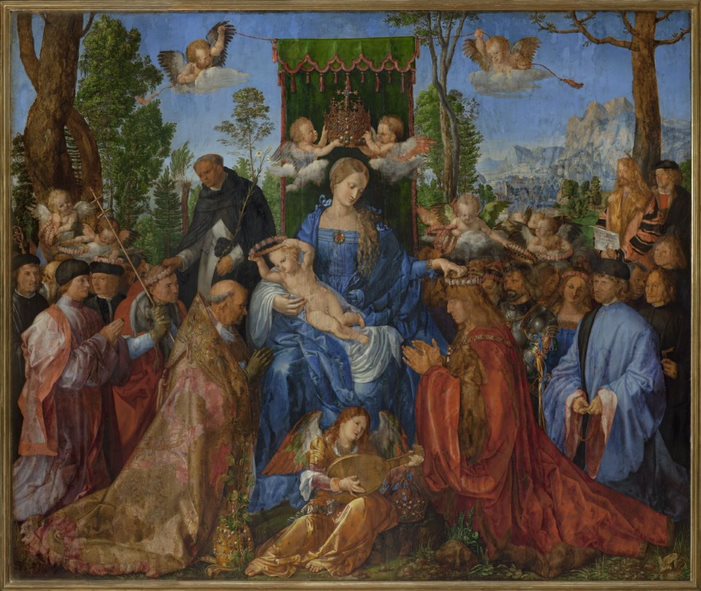
Albrecht Dürer - Feast of the Rose Garlands | Highlights from...